PEO Atlas
What a PEO actually handles
A PEO can take a large part of the employer back office off your plate: payroll, benefits, HR admin, compliance support, workers' comp, and onboarding. You still run your business and manage your people day to day.
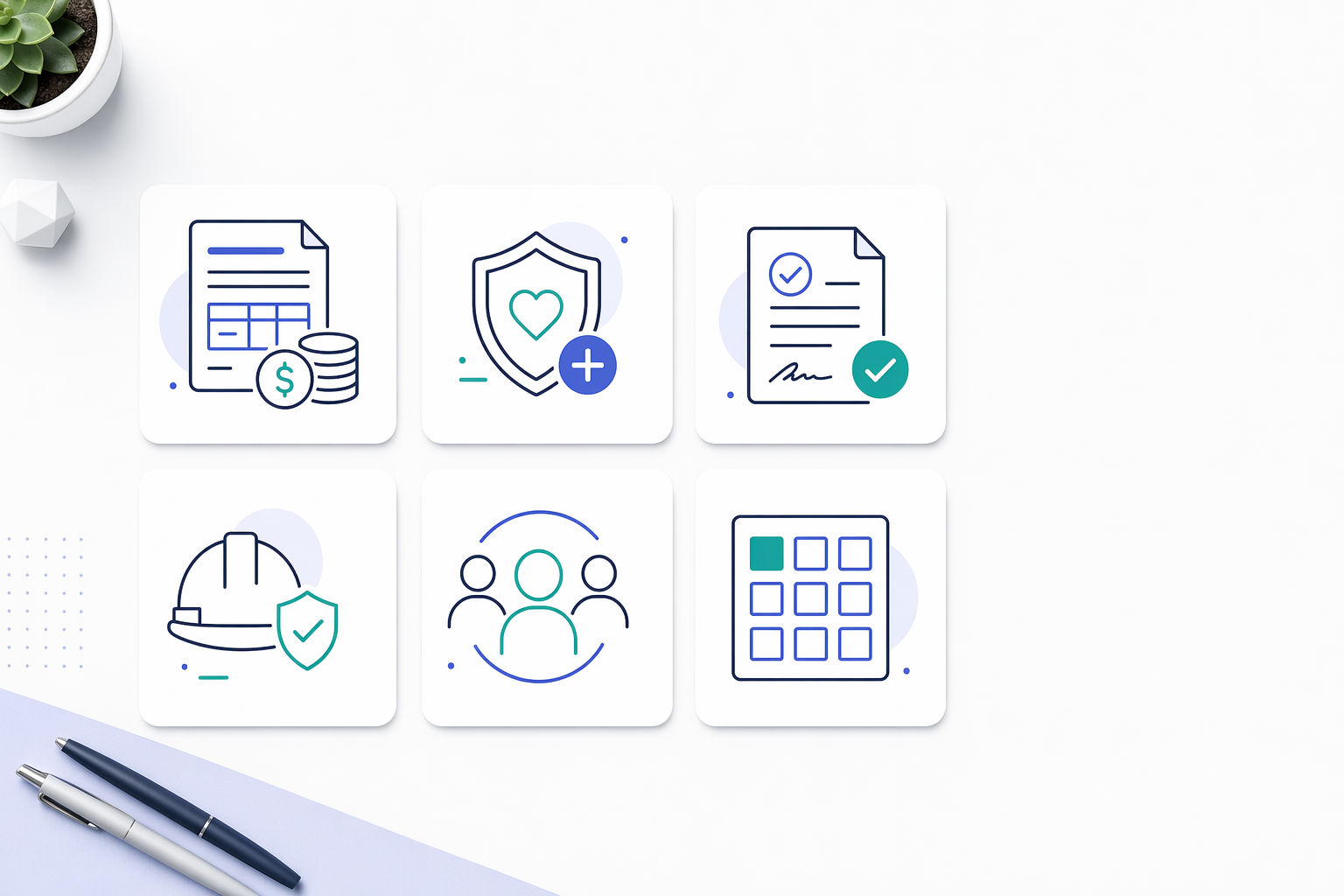
How a PEO runs payroll and files payroll taxes for you — direct deposit, W-2s and 1099s, multi-state withholding, and year-end filings — what it covers, honest cost ranges, and how to get matched.
Open → Employee benefits through a PEOHow a PEO gives a small business access to big-company benefits — health, dental, vision, retirement, and more — by pooling employees, what it really means for cost and choice, and how to find the right one.
Open → HR compliance and paperworkHow a PEO helps keep your business compliant — employee handbooks, required notices, I-9s, state and federal filings, and labor-law updates — what's included, what isn't, and how to get matched with a provider.
Open → Workers' comp and workplace riskHow a PEO handles workers' compensation coverage, claims, and workplace-safety programs — often with pay-as-you-go premiums — what to expect, honest cost ranges, and how to find a provider that fits.
Open → Hiring and onboarding supportHow a PEO supports hiring and onboarding — offer letters, background checks, new-hire paperwork, and onboarding workflows — what they do and don't handle, and how to get matched with the right provider.
Open → HR admin and HR technologyHow a PEO gives you an HR platform and admin team — self-service portals, PTO tracking, document storage, and reporting — what the technology covers, what it costs, and how to compare providers.
Open →What a PEO handles, in plain English
A PEO, or Professional Employer Organization, helps a business manage the employer side of running a team. That usually includes payroll processing, payroll tax administration, benefits access and enrollment, HR paperwork, workers' comp administration, and support with compliance tasks.
A simple way to think about it: you keep running the company, and the PEO helps run the employer back office. It can replace a patchwork of separate payroll, benefits, and HR admin vendors with one system.
Most PEOs work under a co-employment model. That means the PEO becomes a co-employer for certain payroll, tax, and benefits purposes, but your business keeps control of hiring, firing, pay rates, schedules, job duties, and daily management.
If you are new to the model, our what is a PEO guide explains the structure in more detail.
Payroll and payroll tax
Payroll is usually the first reason owners look at a PEO. A provider may run payroll, calculate withholdings, issue pay stubs, help with direct deposit, handle year-end forms, and administer payroll tax filings and payments through its system.
That can reduce manual work and lower the chance of missing deadlines, but it does not remove your responsibility to review data and approve payroll accurately. You still decide who gets paid, how much, and when.
Some businesses only need payroll support, while others want the full employer stack. If payroll is the main problem, start with our page on payroll and tax support.
Rules and filing requirements vary by state, and provider workflows differ, so ask exactly what payroll tasks are included before you sign.
Benefits, HR admin, and employee support
Many small businesses use a PEO to get help with employee benefits and the paperwork around them. That can include medical, dental, vision, retirement plan access, enrollment support, deductions through payroll, COBRA or similar administration support, and employee self-service tools.
On the HR admin side, a PEO may help with onboarding forms, handbook tools, policy templates, time-off tracking, job documentation, and maintaining employee records in one platform. Some also offer HR support teams to answer general process questions.
This does not mean the PEO takes over management decisions. You still choose compensation, approve time off policies, decide how to hire, and manage performance. The provider helps with administration and systems, not the day-to-day leadership of your team.
Benefits availability, plan designs, and costs vary by state, industry, headcount, and the provider. General information only: for plan details or legal requirements, review the documents carefully and confirm specifics with the provider and, when needed, an accountant or attorney.
Compliance support and workers' comp
A good PEO can also help organize compliance-related employer tasks. That may include required notices, onboarding documents, wage and hour tracking tools, I-9 and W-4 workflow support, ACA-related administration support for eligible businesses, and guidance on routine HR processes.
Many also include workers' comp administration and claims support, plus safety resources or risk management tools. For a growing business, that can be useful because workers' comp, payroll classification, and reporting can get messy fast.
Important: this is general information, not legal, tax, or insurance advice. State rules vary, and a PEO is not a substitute for an attorney, accountant, or licensed advisor when you need formal advice.
You should also ask whether the provider is an IRS-Certified PEO or has ESAC accreditation. Those are useful trust signals, especially when a provider will be involved in payroll tax and benefits administration.
What a PEO usually does not handle
A PEO can remove a lot of admin, but it does not run your business for you. It usually does not decide whom to hire, fire, promote, schedule, discipline, or pay. Those choices stay with the business.
A PEO also is not the same as legal counsel, a CPA firm, or a custom HR department for every strategic issue. Some providers offer broader HR support than others, so do not assume every service is included.
This is why contracts matter. Read the full agreement and look closely for vague or bundled fees, long lock-in terms, hidden setup charges, hidden exit fees, auto-renewal language, and pressure to sign quickly.
Cost is usually charged either as a per-employee-per-month fee or as a percentage of payroll. A broad market range can be roughly $40-$160 per employee per month, or roughly 2%-12% of payroll, depending on headcount, services, industry, and state. These are not quotes.
How PEO Atlas helps
PEO Atlas is not a PEO, payroll company, benefits broker, insurer, or law firm. We are a free matching service that helps businesses compare PEO and HR outsourcing providers based on their size, state, and needs.
We collect business and need details only, such as your business name, headcount, state, what you need help with, and your contact information. We do not ask for EINs, bank account numbers, employee Social Security numbers, full employee rosters, income details, or health records.
If you want help comparing options, you can get matched for free. You stay in control: compare providers, ask questions, read the contract, and choose whether to move forward.
A PEO can handle much of your payroll, benefits, HR admin, and compliance workload, while you keep control of your business and your employees.
Ready to compare PEO and HR providers?
Tell us your headcount, your state, and what you need help with. We match you, free, with vetted providers — you compare quotes and choose who to work with, and you read the contract before you sign.